
A music video treatment is the brief you approve before anyone boards or shoots.
This page defines the artifact. It is not a full writing course. For how to write the intro and each section, use the pillar guide. For finished packets, use the examples post.
Read this first, then leave. Need the writing method? Use the step-by-step writing guide. Need the opening paragraph? Copy the short intro template. Need finished packets? Use the 10 fictional examples. Need empty headings? Use the Treatment For Music Video Template. Need the timed draft? Use the 60-minute workflow.
What a music video treatment is
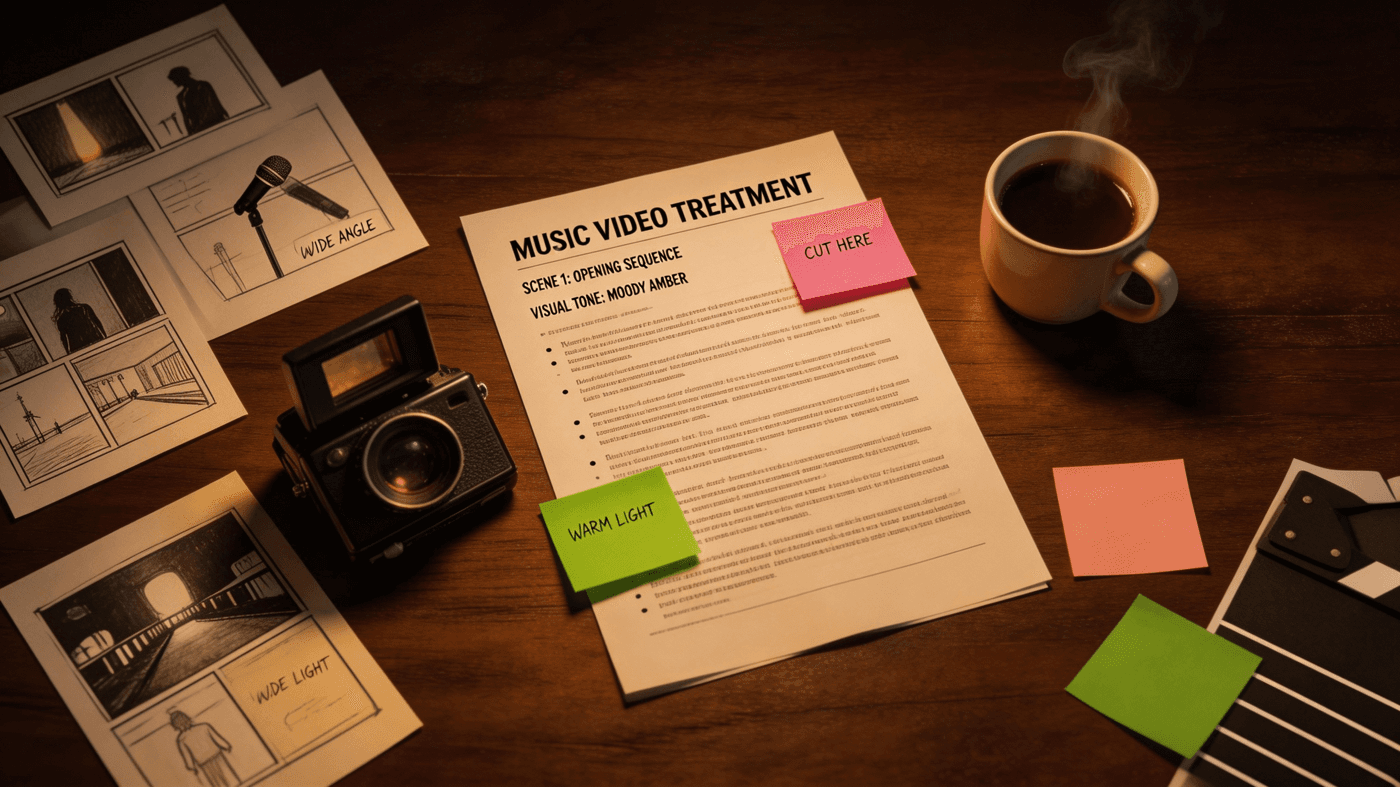
A music video treatment is a short pre-production document that states the concept, visual direction, and scene flow of a music video so everyone can approve the same idea before storyboard, budget, or production. It is usually 1–5 pages or slides. It is written in prose plus references, not in panels.
That is the whole definition. The rest of this page only bounds it.
Teams say "we need a treatment" and mean different files. That mismatch is what this page exists to stop.
What it is not
| Artifact | Job | Why it is not a treatment |
|---|---|---|
| Storyboard | Frame-by-frame "how" | Panels, camera, continuity. Comes after approval. See treatment vs storyboard. |
| Shot list | What to capture | A checklist for set or generation, not a concept pitch. |
| Script | Spoken scenes and action lines | Most music videos are driven by the song. A treatment can include a thin narrative; it is not a screenplay. |
| Mood board alone | Taste | Images without a concept, beats, and constraints are decoration. |
| Prompt dump | Generation notes | Useful later. They do not replace a brief a label can sign. |
If your document only works as one of the rows above, rename it and write the missing brief.
Who writes it, and when
Who: usually the director, answering a brief from the artist, manager, or label. An artist or producer can write a first pass on a small project. The name on the cover matters less than whether one person owns the decisions.
When: after the song intent is clear and before storyboard, shot list, or schedule. The healthy order is: song intent → treatment → storyboard → shot list → shoot or generation.
Write one as soon as the idea needs a yes, a no, or a scoped revision. Do not board a video you have not agreed on.
Readers are not all directors:
- Artist / management: does this match the song and the identity?
- Label / commissioner: is it on-brand and feasible?
- Producer: what will it cost in time, people, and risk?
- Director / DP / design: what visual rules do we execute?
A treatment that only speaks to one of those groups will fail with the others.
A five-line minimal example
Fictional song. Enough to show the artifact — not a full pitch. For longer packets, use the examples post. To turn this into a real document, use the writing guide.
Logline: A performer stays in one apartment from stillness to a chosen exit, not a rescue.
Concept: Isolation starts as comfort; the last chorus leaves the same room on purpose.
Look: Cool static wides in the verses; warmth and motion only after the pre-chorus.
Beats: Verse = environment wins. Chorus = performer acts. Bridge = the room breaks. Outro = empty frame.
Constraint: One location, no extras, night interiors, no weather or VFX.
That is already a treatment. Adding poetry does not make it more true.
How long, and where the template lives
Pitch treatments are usually short and visual. Internal drafts can be longer if the project is complex. The test: can a stakeholder understand direction in under three minutes?
For section order and page habits, use the treatment format page. For empty headings, use the template page. For the product-facing hub that collects those resources, start at Music Video Treatment.
Definition first, then write or preview
This page stops at the definition. Write the packet with the pillar guide. If you later want moving sketches of an approved look, preview scenes in the AI music video generator. You do not need AI to have a treatment.
Frequently Asked Questions
What is a music video treatment in one sentence?
A music video treatment is a short pre-production brief that states the concept, look, and scene flow of a music video so artists, labels, and directors can approve the same idea before storyboard or production.
Is a treatment the same as a storyboard, shot list, or script?
No. A treatment decides what the video is and why. A storyboard frames shots. A shot list lists what to capture. A script is dialogue- and action-led; most music videos are driven by the song, not spoken scenes. Details: Music Video Treatment vs Storyboard.
Who writes a music video treatment, and when?
Usually the director writes it after the song brief and before storyboard. An artist, creative director, or producer may write a first pass. Write it as soon as the idea needs a yes or no, not after you have already boarded the video.
How long should a music video treatment be?
Most pitch treatments are 1–5 pages or slides. A low-budget or internal note can be one page. If a reader can repeat the concept and look in under three minutes, the length is fine.
Do I need a treatment for a low-budget video?
Yes, in a short form. One page that names the idea, three beats, the look, and one limit is enough to keep a cheap shoot from drifting.
Where do I go next if I need to write one?
Use the step-by-step writing guide for the intro template and section lines, the 10 examples for finished fictional packets, and Treatment For Music Video Template for empty headings.
Industry references
More Posts
![10 Music Video Treatment Examples You Can Actually Use [2026]](/_next/image?url=%2Fimages%2Fblog%2F10-music-video-treatment-examples.png&w=3840&q=75 "10 Music Video Treatment Examples You Can Actually Use [2026]")
10 Music Video Treatment Examples You Can Actually Use [2026]
10 detailed, adaptable music video treatment examples with concept logic, scene progression, visual rules, references, and revision notes.
How to Make a Music Video Treatment in 60 Minutes
Draft a music video treatment in 60 minutes: timed steps, a first-pass checklist, and links to the full writing guide, intro template, and blank template.
How to Write a Music Video Treatment (With Intro)
Learn how to write a music video treatment — and any short video treatment — with a copyable intro, section templates, and a send-ready checklist.